Skincare Declutter: How to Review Your Sets and Products
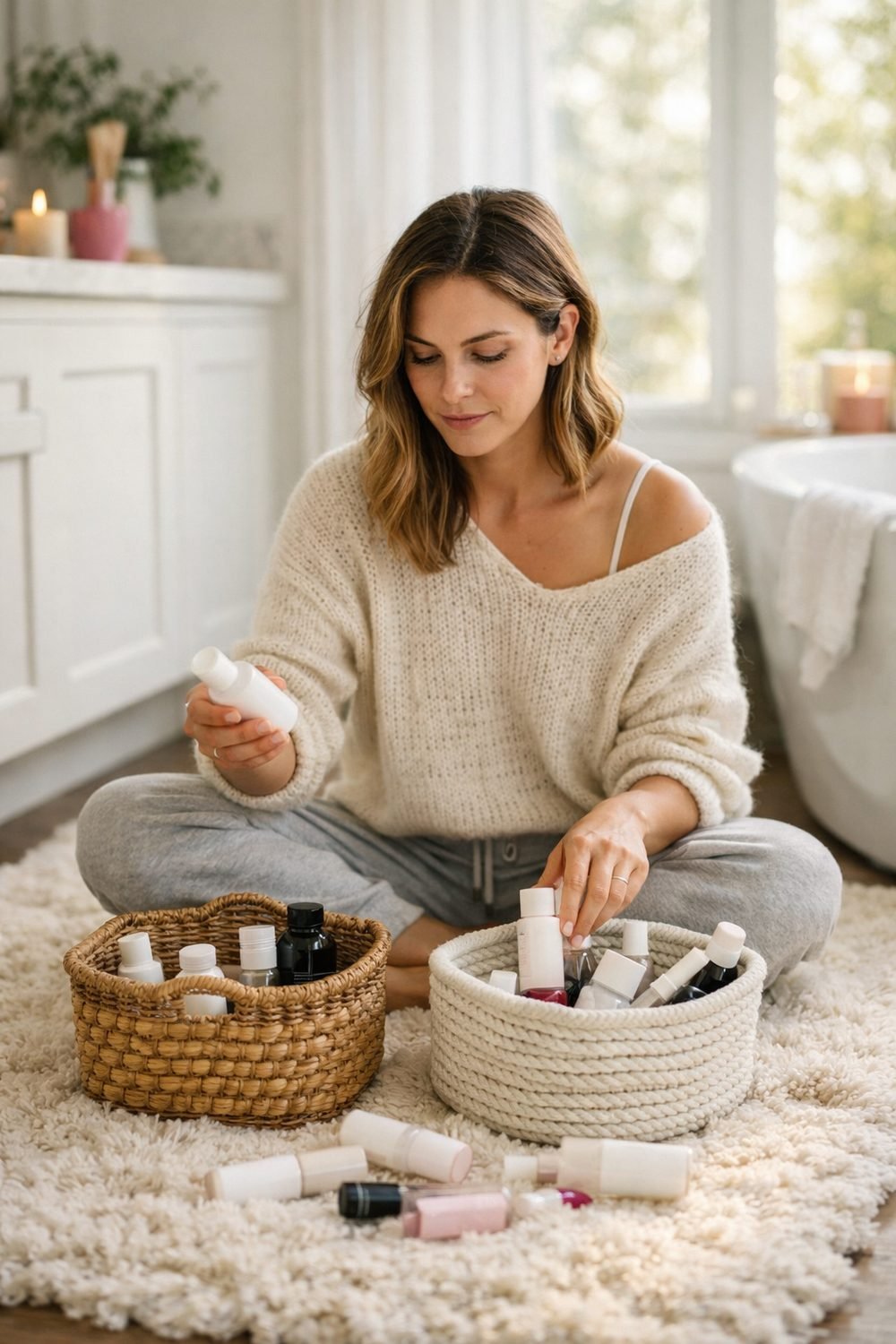
Before you go looking for the best skincare sets, it helps to know what is already on your shelf. This skincare declutter guide shows you how to review what you own, check open dates and storage notes, and spot duplicates, so you only keep or buy what you will actually use.
A first real skincare declutter is easy to put off, and many people wish they had started sooner. Start with one drawer, since it may take less time than you expect. It took most of the afternoon, because that drawer led to the bathroom cabinet, which led to the bag under the sink, which led to three travel pouches I'd forgotten about. You may find duplicate moisturizers, a sunscreen you don't remember buying, and a serum that has changed color.
Most of us own more skincare than we use, even if we never bought one of the best skincare sets. That's not a failure. It's just what happens when you try things, get gifts, and pick up "one more" on a busy day. A short review helps you see what you actually have, so you can use it up, share it, or let it go without guilt.
This skincare declutter checklist walks you through how I do it now. It's calmer, quicker, and I don't end up with a pile of half-used bottles I feel bad about.
Short on time? Our top picks: Notion, Google Sheets, Apple Notes and Google Keep. See all picks

What you need
- A clear table or counter, wiped down
- A towel or old sheet to set products on
- A pen and paper, or a notes app on your phone
- A few small boxes, bags or bowls for sorting
- Small labels or masking tape and a marker
- Good light, ideally near a window
- About an hour (less if your collection is small)
You don't need fancy organizers to start. It's better to skip buying any until you're done. You won't know what size or shape you need until you see what's left.
Step 1: Gather your whole skincare collection in one place
Put every skincare product you own on the table. Not just the bathroom shelf. Check your bag, your gym bag, your car, your bedside table, your desk at work if you can, and any travel pouches. Samples count too, and so do the minis from any travel skincare kit.
Lay it all out on the towel so you can see each item. Don't sort yet. Just get it all in one spot.
This part can feel a little embarrassing. When I saw four lip balms lined up next to each other, I laughed out loud. That moment is the whole point, though. You can't make good choices about things you can't see.
Tip: Take a quick photo of the whole pile before you start. It's oddly motivating to look back at later, and it helps if you get interrupted and need to remember where things came from.
Step 2: Check the open dates
Pick up each product and look for the date you opened it, if you wrote it down. Some people mark the bottom with a marker such as a Sharpie or a sticker. If you did, great. If you didn't, you're like most people, me included until a couple of years ago.
For anything without a date, make your best guess. Think about when you bought it or when you started using it. "Last summer" or "around my birthday" is good enough for now. Write your guess on a small piece of tape and stick it on.
Then look at the product itself. Has the smell changed? Has the color shifted, or has it separated in a way it didn't before? Is the texture lumpy, watery, or grainy when it used to be smooth? These changes don't tell you everything, but they're worth paying attention to.
Tip: From today on, write the open date on every new product the day you open it. It takes five seconds and saves you the guessing game next time.
Step 3: Read the maker's storage and replacement notes
Now look closely at each label. Many products have a small symbol of an open jar with a number and the letter M next to it, like "6M" or "12M." That's the maker telling you how many months they suggest using it for after opening. Some products also have a printed expiry date, often stamped on the bottom or the crimp of a tube.
Follow what the label says. The maker knows their formula better than any general rule online. If the packaging is gone or the print has rubbed off, check the brand's website or contact them. If you have sensitive skin or a skin condition and you're unsure about a product, a pharmacist or dermatologist is the right person to ask.
Storage notes matter too. Some labels say to keep the product away from heat or sunlight, or to close it tightly. If a product has been sitting on a sunny windowsill or in a hot car all summer, keep that in mind when you decide.
Tip: Use your phone camera to zoom in on tiny print. It's much easier than squinting, especially on small tubes and samples.

Step 4: Group duplicates, including skincare sets and vitamin C
Start sorting products into groups by type. Cleansers together. Moisturizers together. Sunscreens, serums, toners, eye creams, masks, lip products, and so on.
This is where the surprises usually show up. You might have three gentle cleansers and no sunscreen you actually like. Or five sheet masks, a few gift sets, and nothing for your dry hands. Notice what you have more than one of, and notice what's missing.
Within each group, line them up from "opened first" to "opened last." That way you can see which one to finish first. Honestly, this one habit has saved me more money than any sale ever did.
Tip: If you have lots of duplicates in one category, that's a sign to pause buying in that category for a while. A little note on your phone that says "No new cleansers until these are gone" can work better than you might expect.
If you're still working out what you even need day to day, our free AM-PM Routine Chart for Skincare Beginners can help, and you can grab it by joining the email list in the box on this page.
Step 5: Set aside what you do not use
Now be honest with yourself. Go through each group and pull out anything you haven't used in a long while, anything that didn't suit your skin, and anything that seems past its time based on the label and how it looks.
Make three small piles or boxes:
- Keep: Things you use, like, and that are still within the maker's suggested time.
- Share: Unopened or barely used items that are still fine, that a friend or family member might want.
- Dispose: Anything past its date, changed in smell or texture, or that you just know you won't use.
For sharing, I'd only pass on things that are unopened or clearly fresh. Opened products are a personal choice, and some people aren't comfortable with them. Ask first. Some local shelters or charities take unopened toiletries, but rules vary, so call ahead.
For disposal, check your local council or waste service for how to handle packaging. Some containers can be recycled once they're empty and rinsed, and some can't. Pumps and droppers are often tricky. It's worth a quick look on your local service's page.
Tip: Don't keep something just because it was expensive. It's easy to hold onto a pricey face oil for months out of guilt. It made my skin break out every time. The money was already spent. Keeping it didn't bring it back.
Step 6: Write a skincare inventory tracker
Last step, and it's the one people skip. Please don't. A list prevents buying the same thing twice.
Write down everything in your Keep pile. For each item, note:
- The product name and type
- When you opened it (or your best guess)
- The maker's suggested use-by time, if there is one
- Roughly how much is left
Keep your skincare inventory tracker somewhere you'll actually see it. Mine lives in my phone notes, and I check it before I shop, though a app like Google Sheets works well too. If you'd rather have a printable template ready to fill in, the Product Inventory and Expiry Tracker below this post is set up for exactly this, with spaces for open dates and replacement notes.
Then put your Keep items back, with the oldest ones at the front. Put the rest in a drawer or box as backup stock.
Tip: Set a reminder on your phone, perhaps in an app like Todoist, to do a quick review every few months. The second time is so much faster. Mine takes about fifteen minutes now.
Troubleshooting
"I feel overwhelmed and want to quit halfway."
Totally normal. Stop at whatever step you're on and do just one category, like cleansers, today. Come back to the rest later. A half-done declutter is still better than none.
"I can't find any date or symbol on the product."
Search the brand's website or contact their customer service. If you still can't find anything and the product looks or smells off, I'd lean toward letting it go. When in doubt about your skin, ask a pharmacist.
"I keep wanting to save things 'just in case.'"
Give yourself a small "maybe" box with a date on it. If you haven't reached for anything in it by that date, it goes. This takes the pressure off deciding everything right now.
"My partner or roommate's products are mixed in with mine."
Set theirs aside in their own pile and let them sort it. Don't toss anything that isn't yours. Trust me on this one.
"I finished, and two weeks later it's messy again."
That usually means things don't have a clear home. Give each type its own spot, even if it's just a small bowl. And keep using your list before buying anything new.
Tools that can help with your skincare declutter
You don't need much to review your products, but a few simple tools can make the job easier and help the habit stick. Here are some real options that fit different styles.
Notion
A good fit if you like building your own lists and want your inventory, open dates and notes in one place. Check how much setup you're willing to do, since a blank page can feel like a lot at first.
Google Sheets
Suits anyone who likes columns for product name, open date and replacement time. Check that you'll actually open it on your phone when you shop, or it won't help.
Apple Notes
A simple choice if you already use an iPhone and just want a quick running list. Check whether you'll need access on other devices before settling on it.
Google Keep
Good for quick checklists and reminders, especially if you like color-coded notes. Check that it fits how you already organize things, so you don't end up with scattered lists.
Todoist
Handy for setting a repeating reminder to review your skincare every few months. Check which features come with the free version before you rely on them.
Brother P-touch label makers
Useful if you'd like neat open-date labels on bottles and boxes instead of masking tape. Check that the label tape suits small, curved or damp surfaces before you stock up.
Sharpie permanent markers
An easy way to write the open date right on a tube or bottle base. Check that the ink stays put on your packaging, and test on a spot that won't matter.
Please check current plans and prices on each brand's own site before you choose.
FAQ
How often should I review my skincare?
There's no set rule. Every three or four months works well for many people, along with a quick check when seasons change. Pick a rhythm you'll actually stick with.
Is it okay to use a product after the date on the label?
What's safe for your skin depends on you, so check with a professional if you're unsure. The maker's label is the best guide, and if you're unsure, check the brand's page or ask a pharmacist or dermatologist. It pays not to take chances with anything you put on your face.
What do I do with all the samples and skincare gift set minis?
Put them in one small pouch and use them first, especially when traveling. If a sample has no date and you can't remember when you got it, it may be time to let it go. You can stop accepting samples you know you won't try.
Do I need special containers or organizers?
Not at all. Small bowls, shoeboxes, or zip bags work fine. If you want something later, wait until you know what you're keeping so you buy the right size.
Your next step is simple: pick one drawer or one bag and start with Step 1 this week. If you want help planning what to use morning and night, grab the free AM-PM Routine Chart for Skincare Beginners by joining the email list. And if you like having everything in one place, take a look at the Product Inventory and Expiry Tracker and the Beauty and Skincare Planner and Checklist Bundle below this post.
Printables and tools that can help
Product Inventory and Expiry Tracker
A printable tracker for skincare, makeup and hair products: date opened, replace-by date and...
See detailsBeauty and Skincare Planner and Checklist Bundle
A printable bundle with a 30-day goal page, weekly planner and setup checklists for organizing a simple...
See details